Hello Raziq Rauf, welcome to Wings & Spikes. Congratulations on getting your book published! What an accomplishment! And this is such a well-written and beautifully-produced book! Let’s start with your intention of writing this book. You write a hugely popular Substack, Running Sucks.
Why did you decide to write a book on running?
This Is Running encapsulates my past 25 years of experiences. I’ve been writing and running since the 90s! If I spend time doing something, I’m the type of person who wants to know all about it.
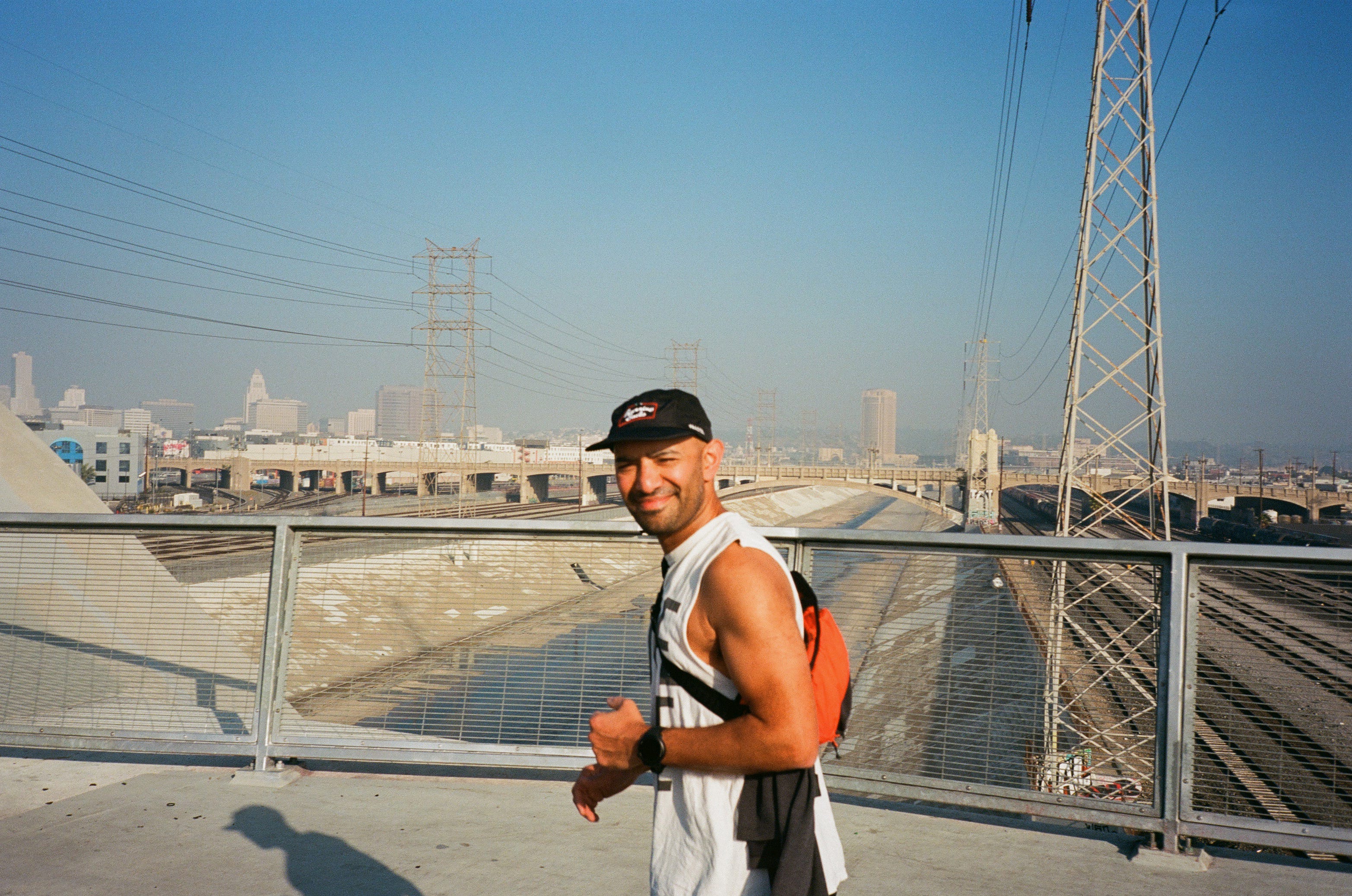
(Raziq Rauf, photo by Carly Palmour)
In my early running days, I ran a lot of charity races, 5k and 10k races. I raised a serious amount of money. I was very focused on a few causes. When I moved to Los Angeles in 2014, and signed up for races in Downtown LA, Griffith Park, Santa Monica, and Pasadena, because it was a great way to learn about my new home. In recent years, running has become fashionable. I write about running clubs. I’m interested in why other people run. This whole time of running myself and observing how others run gave seed to the idea of a book. I also wanted to give the world a book that doesn’t exist.
Tell us about the book!
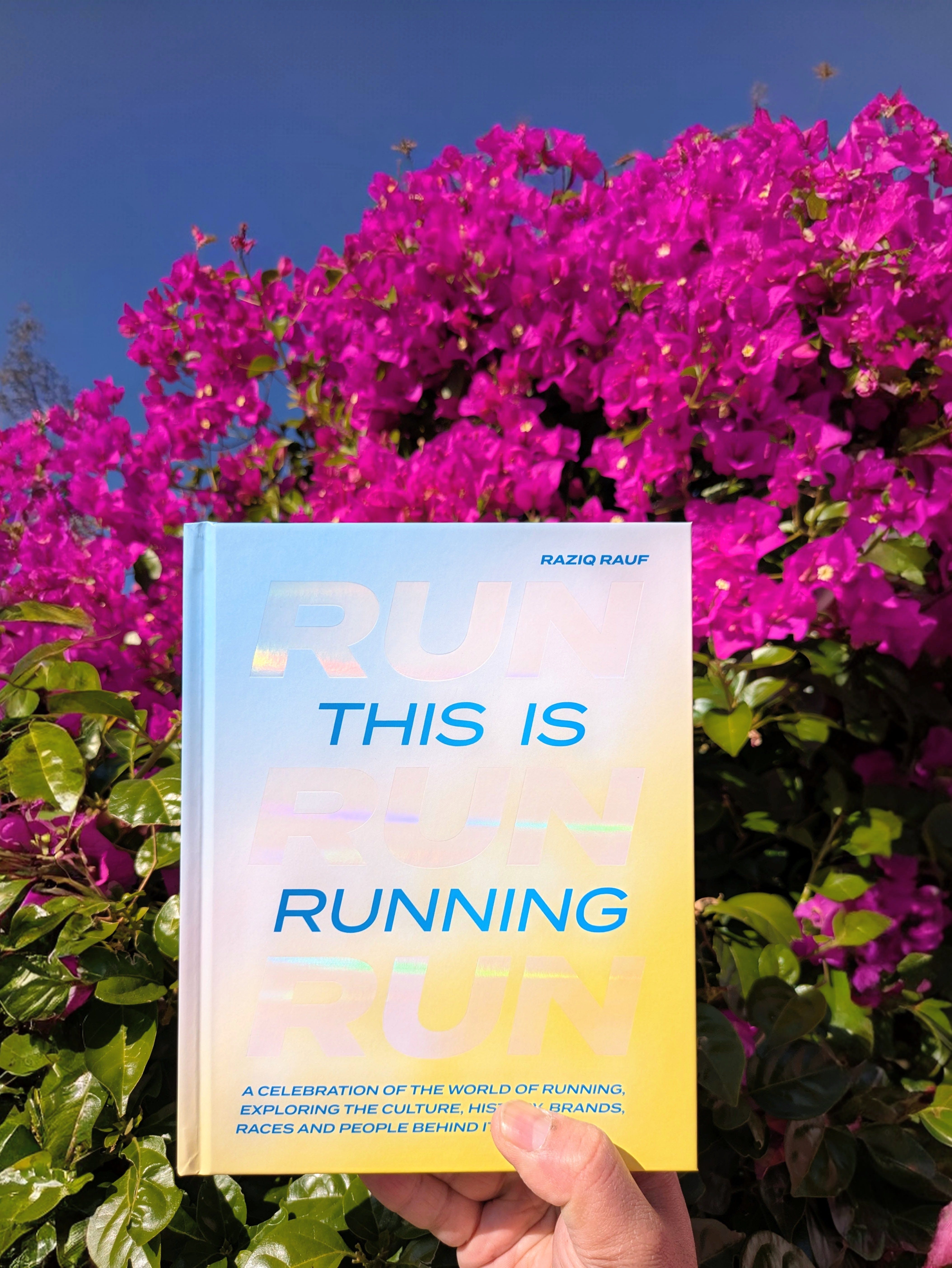
It’s a running book with 11 chapters, covering all different aspects of the running world, with a global perspective. It covers topics such as health and technology, super shoes, marginal gains, future of running, brands and run clubs. The opening pages are about essential races and different ways of running. I hope that whatever your running interests are, you’ll find it in this book. I have interviewed people from my two home countries, the US and UK. I also interviewed experts from France, Germany and Japan, trying to make it as global as I can.
Save the Date! On Wednesday, April 8th, we will be celebrating the launch of This Is Running at Vroman’s, Pasadena’s local bookstore! Join us if you are in the Los Angeles area!
My intent is also to cover different ways people run. There’s the Boston Qualifier gang: as you imagine, they wear the AlphaFlys and the lightest clothing. They’re the optimize-everything bunch. The extrinsic validation of Boston qualification, which comes with pressure, is for sure one way to run. Then there’s another way, like running with friends, and for mental health. I try to examine all the ways runners interact with a particular strand of running culture that’s the best for them. Sometimes you just have 45 minutes to run from your backdoor. Enjoy it.
There are also hundreds of beautiful photos in the book from top photographers. One photographer, David Miller, won a British photography award. He’s got 5 photos in the book.
This post of Wings & Spikes’s is sponsored by Kibra. Kibra is made for women who find strength by turning inward—and who choose to treat themselves with gentleness. Kibra designs high-performance activewear as a “coming home” practice for body and mind. Its aesthetic is inspired by Mediterranean sunlit elegance, and guided by the rhythms of Eastern wellness—movement to circulate energy, stillness to nourish the spirit.
Fascinating. What was a particularly challenging chapter to write?
The technology chapter was difficult to write. It was hard to track down a lot of the tech that doesn’t exist any more. I had to find interviews and documents that are hard to get to. I did manage to find an interview about something that doesn’t exist in print anywhere. I was very proud of that.
I also have a chapter on women and the female perspective. That was difficult to write as a male runner, and maybe it’ll be hard for some women to take that chapter seriously. I opened that chapter from a very personal perspective. If readers want to get deeper on women and running, Maggie Mertens’s bookBetter Faster Farther: How Running Changed Everything We Know About Womenoffers a great history lesson.
You write so much about the running culture. How would you summarize the Los Angeles running culture?
LA running culture reflects LA, which is easily described as a collection of completely separate neighborhoods. You can find your running club in your own neighborhood without ever venturing out elsewhere. Each neighborhood also might have multiple run clubs, some focused on the road and some on trail running. This is why I love LA. This is my home and there is something for everyone. You can make friends and find the type of running you like the most, whether that’s track, road or trail.
We’re living through another running boom at the moment. Why do you think the popularity of running hasn’t faded after the pandemic?
Running has lasting power. If you find it, it never leaves you. Everyone who’s found running becomes an evangelist for running. Some of them might move to Hyrox and triathlon. But there’s always more to discover… if you run one marathon, you might want to do all 6 majors, and then maybe a 50-miler, 100-miler. You’re always trying to be better, going faster or longer. It’s kind of a capitalistic mindset.
Run clubs are key to the LA running culture: you have Blacklist LA: they’re one of the original run crews. I love seeing how well they’re structured: how each run is integrated with seeing art in various parts of LA. It helps me discover the art scene in my city. A truly original idea. Another noteworthy club is Silverlake Track Club. They recently raised over $50k for the Eaton and Palisades fires. They recently organized a relay going from Altadena to Palisades. They all do such a great job connecting runners to their own communities.
Running brands getting deeper into various aspects of it makes the sport attractive to people who might not otherwise find running. 10 years ago, technical apparel might not have looked very fashionable. We all remember when Lululemon was high fashion. Now you have Satisfy, On, Tracksmith, Brandit… they make running very attractive.
The other reason why I pay attention to running brands is how they connect to our broader culture. Satisfy has a big theme of the American West, cowboys and rodeo. There’s a fashion throughline. What does the American West signify now? Do we want to glamorize it?
How was the publishing process?
I pitched a publisher with a few ideas about 2 years ago. Back then, I had only been writing my Substack for a year. I was only trying to get some feedback and wasn’t expecting a response. My pitch was initially ignored, of course, but a few months later, I got an email from the publisher, saying, “We want this book”. We worked on a mixture of ideas, broader than what I write on my Substack. Together, we created chapters and flushed it to a book.
That process took almost 6 months. My editor has been fantastic the whole time. I hit all my deadlines. One of the reasons why I went with this publisher, Batsford, is because they make beautiful books and have won awards with their covers. If the book is to stand out on the shelf, I have to make it beautiful.
That’s part of my strategy to have longevity as an author. I’ve only been writing about running for 3 years. In the field of writing about running, I’m not very well known yet.
Getting it published already feels like a success. Now I want to get to 1000 copies, which will be a big personal goal. I’d love for that to happen on publication day, though numbers are arbitrary.
What’s your writing routine?
I try to write a minimum of 500 words a day as soon as I can in the morning, after school drop-off. I sit down at 9am and get words down onto the page. I edit them later. This routine keeps the process relaxed and low-pressure.
The research process is a bit chicken-and-egg. Sometimes I find things out from research. Other times I have a definite idea that needs research to validate. The latter takes a lot longer because I want to be thorough.
How’s your running going?
I’m coming back from an injury. I put on weight, but have been going to the gym, and working with a personal trainer. I’m going to be a heavier runner, but that’s ok.
The only race I want to do this year is an unsanctioned half marathon, put on by Orchard Street Runners. This half happens the night before the New York City Marathon, so I have 9 months to train for that.
Whenever I travel, I try to engage with the local running crews and culture. I’m looking forward to the race.